
There is a math game that feels like magic. It teaches students to use notation, replaces thousands of math worksheets, can be used across nearly all content areas in math, encourages creativity, and solves math confusion in both students and teachers. It can be played with kindergartners and high schoolers at the same time, and no one is bored.
Plus, it’s free.
How about that?
When I play math games, I want the engine of the game to BE math. Not some trick to get children to practice math facts. The only math games we play are the ones that fulfill that single criterion. It also helps if the game has endless play possibilities and can be transformed into other versions. And this game has both.
This is starting to sound impossible, isn’t it? But it’s not. It’s not impossible.
What if I told you the rules were simple, and I’ve yet to meet a child who doesn’t like playing the game? It almost sounds like the perfect game.
It is!
How to Play the Substitution Game
The Substitution Game is ridiculously simple. You replace one number with another way to say it. That’s it.
Start with something you know is true:
1 + 2 = 3
The first player chooses any number and replaces it with another way of saying that number. I could replace 1 with 2 − 1:
2 - 1 + 2 = 3
Now it is the next player’s turn. They can choose any number they see. Maybe they choose 3 and replace it with √9:
2 − 1 + 2 = √9
The next player might replace 2 with ½ × 4:
2 − 1 + ½ × 4 = √9
And you keep going. Each player replaces one number with another way of saying that number. Whatever a player adds becomes part of the game and gives the next player more numbers they can choose from.
This is where the possibilities open up. Any number anywhere in the equation can be substituted, and a substitution can be as simple or as complex as the player wants. A child might replace 2 with 4 − 2, or they might replace it with ½ × 4. A substitution isn’t limited to one operation, two terms, or any particular kind of notation. It is limited by what the players know and what they can imagine. And because every number introduced in a substitution is available for substitution on a later turn, the possibilities are endless.
There is no particular place you have to end. You can play for five minutes or fill an entire whiteboard.
And that is the game.
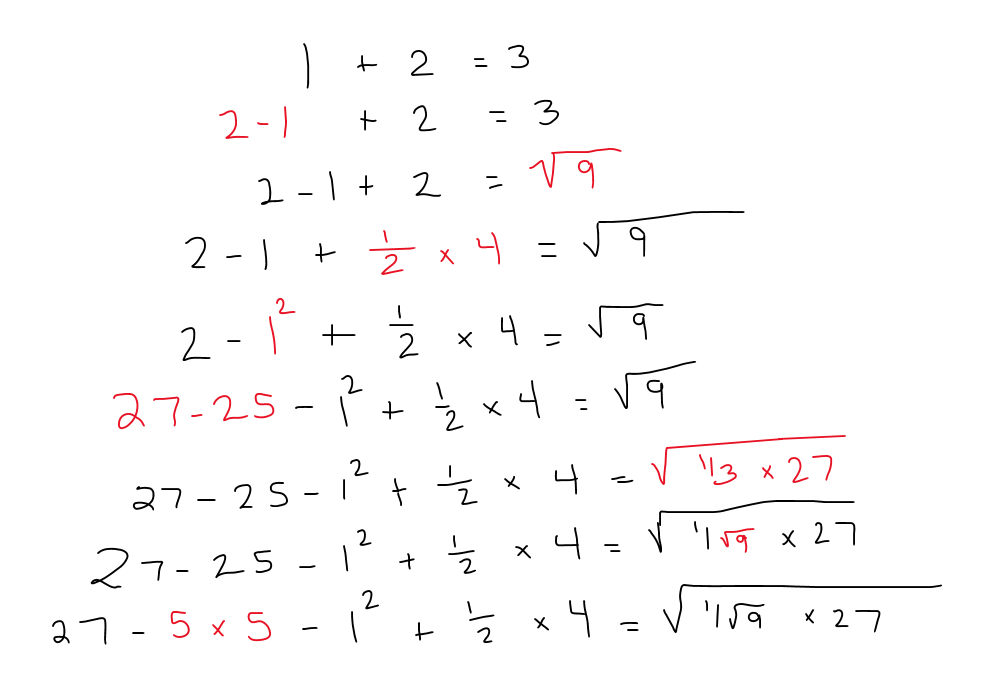
Your 6 year old doesn’t need to understand all the symbols on the page. They just need to substitute a single number.
This is part of what makes the game so useful. We do not spoon-feed complicated expressions and ask them to figure out what somebody else did. They watched the complexity develop because they made every substitution themselves. Every piece of the expression has its origin in the math they were thinking about.
What is This Game Doing?
I wrote about the Substitution Game ages ago on my old blog. I'm rewriting this article while I'm also reading Paul Lockhart's book, The Mending of Broken Bones. This book has convinced me even more of the need to play this game and helped me understand why such a simple game seems to solve so many math problems, including my own.
1. Notation: Learning to Say Mathematical Ideas
Mathematical notation is so familiar to us that it is easy to confuse the notation with the mathematics itself. Paul Lockhart makes an important distinction: the number four is not the word four, the symbol 4, the Roman numeral IV, or any of the other ways human beings have devised to represent it. Four is an abstract mathematical idea. The symbols are ways of encoding that idea so that we can think about it, work with it, and communicate it to someone else.
Caleb Gattegno approached this same idea by teaching students that numbers have many names. In the “Who is Betty?” lesson in my Build and Learn: Cuisenaire Rod Structures course, students first consider how one person can have many names or descriptions while remaining the same person. That awareness is then brought into mathematics. Eight can be called 8, but it can also be called 4 + 4,
10 − 2, 2 × 4, or any number of other names.
Lockhart makes the same observation: every number has infinitely many names. Twelve can be written as 12, 5+7, 18−6, 3×4, and endlessly more. He describes arithmetic fluency as becoming facile and flexible enough to move among these different representations, much as an interpreter moves between languages.
This is quite different from the way children often encounter mathematical notation. A page of arithmetic might give a child:
The child sees the operation symbol, performs the indicated operation, and writes 12. The notation functions almost like a set of instructions: add these numbers, subtract these numbers, multiply these numbers, and give me the answer.
Research on children’s understanding of the equals sign has documented the problems that can arise from this kind of repeated experience. Children can come to understand the equals sign operationally, something like “do the calculation and put the answer here”, rather than relationally, as an assertion that the expressions on either side have the same value.
Lockhart makes the relational meaning explicit. He points out that the equals sign has no directionality. 5 + 7 isn’t a problem for which 12 is the answer. Rather,
says that 5+7 and 12 are different names for the same mathematical entity. Because they are equal, one can stand in place of the other.
The Substitution Game gives children practice doing exactly that. The rule is simple: replace one number with another way of saying that number.
If I begin with 8, I might write:
The plus sign didn’t tell me what to do. I chose the plus sign because it expressed what I wanted to say about 8.
Another player might write:
Both expressions have a value of 8, but they aren’t the same expression. One says four and four; the other says two fours. The notation communicates something about how the player is thinking about 8.
A young child who has only addition available might write:
As students acquire more mathematical ideas and notation, they acquire more ways to say what they are thinking. Multiplication, division, fractions, exponents, roots, negative numbers, and parentheses expand their mathematical language.
Lockhart compares the basic activities of arithmetic to the moves learned by a dancer. The purpose of practicing the moves is to be able to combine and arrange them fluidly in order to express something. In the same way, he argues that we should rearrange numerical information in order to say something interesting and meaningful.
The Substitution Game gives children a simple place to do this. Instead of always receiving mathematical statements that someone else has written and being asked to interpret them, they generate mathematical statements of their own. They have to decide what they want to say and then find notation capable of saying it. Other players have to read what they have written, so notation becomes communication as well.
Lockhart calls notation “the messenger, not the message.” In the Substitution Game, the message comes first. The child has a mathematical idea and uses notation to express it.
But the child cannot say just anything. If they are replacing 8, whatever they write still has to be 8. The notation can change. The operations can change. The structure can change. Something, however, must stay the same.
2. Equivalence and Invariance: What Changes and What Stays the Same?
We spend a lot of time in my classes asking two questions: What changed? What stayed the same? This isn’t a skill that is specific to mathematics. All problem solving requires us, in one way or another, to identify unity in the midst of change. Something about a situation varies while something else remains stable, and we have to distinguish between the two.
In mathematics, this becomes especially visible because we deliberately transform things. We rearrange expressions, rename numbers, change the orientation of shapes, alter quantities, substitute one expression for another, and generalize from particular cases. To understand a transformation, we need to know both what changed and what was preserved.
The Substitution Game makes this question unavoidable. The entire game consists of changing a mathematical expression while preserving its value. If I replace 8 with
almost everything I can see has changed. One numeral has become eight numerals. There are now seven addition signs. The expression has a different structure, and it offers possibilities for future substitutions that the single symbol 8 did not make visible.
But one thing has not changed. It is still 8.
Something that remains unchanged through a transformation is called an invariant. Every move in the Substitution Game requires the player to preserve this invariant. I can replace 8 with 4 + 4, 10 − 2, 2 × 4, or 23, but I cannot replace it with 4 + 5. My freedom to change the expression is constrained by the requirement that its value remain the same.
This is also what makes substitution possible. Lockhart describes an equation as an assertion that two expressions are different names for the same mathematical entity. The equals sign has no directionality. If 5 + 7 = 12, then 12 can be replaced by 5 + 7 wherever it occurs because both expressions refer to the same number.
Equivalence, then, does not mean that two expressions are identical. In fact, their differences are often precisely what make them useful. Eight and 1+1+1+1+1+1+1+1 have the same value, but they do not have the same form. One presents eight as a single number; the other exposes eight as eight ones. We can move from 8 to eight ones, and we can compose eight ones back into 8. The value remains invariant while the form changes. The same value is not equivalent to identical.
As the game grows, the transformations can become much more elaborate. A player might replace the exponent 2 in 12, with
That entire expression is another way of saying 2. The player has therefore changed the exponent dramatically without changing its value, and because that value is preserved, the larger expression's value is preserved as well. Now the player is attending to several levels of structure at once: the number being transformed, the expression that replaces it, and the larger expression in which that number is embedded.
Lockhart describes mathematical skill as having a firsthand relationship with numbers and being able to “move information around smoothly and easily” according to their patterned behavior. Caleb Gattegno said he intended to help children become “master manipulators of the symbols.” The Substitution Game gives students repeated opportunities to do exactly that. They aren’t simply finding values. They are transforming mathematical objects while deliberately preserving something through the transformation.
The expression may become almost unrecognizable. The operations may change. New numbers appear. New possibilities for substitution emerge. But through all of that change, the player has to keep track of the unity underneath it.
3. Math Facts: From Known Relationships to Novel Structures
There is no way to play the Substitution Game without math facts. Every move depends on knowing that one expression has the same value as the number it replaces. A player might see 8 and replace it with 5 + 3. That is a perfectly good move.
But after you have played for a while, 5 + 3 is a bit of an obvious fact. “Everybody” knows 5 + 3 = 8. The challenge becomes finding a more interesting way to say it. A player might write
Now the player is still using 5 + 3=8, but they have embedded another known relationship inside it: 25/5=5. This is where the game gets interesting, especially in a group where cleverness and creativity are rewarded.
The next player can look at what has been written and see another possibility. The 5 in the denominator is available for substitution, so they might write:
Look at what has happened simply by stacking those two operations. A student may know about square roots, division, and fractions and still not immediately know how to make sense of this particular expression. Knowing each of the pieces separately does not mean that a novel arrangement of those pieces is immediately transparent.
But the game has given us something enormously useful to reason from. We already know that the whole expression is 8. We know the + 3 has not changed. Therefore,
must be another way of saying 5.
That gives us somewhere to begin. We can reason from the whole toward the parts rather than always calculating from the parts toward the whole. Why must this fraction be 5? What must the denominator mean? How do the pieces fit together? We can also work from the inside out: √25=5 and 25/5=5 and 5+3=8. Both directions confirm the relationship.
And we don't have to stop there. The next player can replace the 25 in the numerator:

Now we have a fraction stacked inside another fraction over a square root. Again, none of the mathematics used to create it has to be new. The player may already know that 1/4×100=25, that √25=5, and that 25/5=5. What is new is the structure produced by composing those familiar relationships.
This is one of the things I find so powerful about the game. Mathematical complexity grows naturally out of mathematics the students already know. We don't have to hand them a page of complicated expressions and teach them a procedure for untangling them. The players build complicated expressions themselves, one perfectly reasonable substitution at a time.
And because every substitution must preserve the value, the growing expression carries information with it. However strange

may look at first, we know it has to be 5. That invariant gives us a foothold from which to investigate the unfamiliar structure.
Math facts, then, are doing considerably more work here than supplying quick answers. They become the raw material from which students construct novel mathematical situations. A child can know 5+3=8, 3+5=8, 25/5=5, √25=5, and 1/4×100=25. The game asks what happens when those known relationships are put together in ways they may never have encountered before.
Lockhart's description of mathematical skill as a firsthand relationship with numbers and their properties and being able to move numerical information around according to the patterns of their behavior is much closer to what is happening here than simply accumulating a larger collection of facts. The more relationships a player knows, the more possibilities they have for transforming an expression, and the transformations themselves create new structures to understand.
This is also why another player's move can be so mathematically productive. I may never have thought to write 5 in any of the above ways. Once someone else does, however, I have to look at it, make sense of it, and decide what I might do with it next. Their mathematical idea has become part of the environment in which I am now thinking.
The facts haven't disappeared beneath all that notation. They are holding the entire thing together.
4. Structure: Expanding What Is Mathematically Possible
As the Substitution Game grows, the player has to learn to see the structure of the expression. Consider where our earlier substitutions took us:
If you were taught to look at a mathematical expression primarily as something to calculate, your first impulse may be to start figuring out its value. But that isn’t the player’s task. The player looks at the expression and asks, “What can I change?“
The answer is any number. That means I first have to see the numbers within the structure. There is a 1 and a 4 in 1/4. There is a 100. There is a 25 under the radical. There is a 3. Every one of those numbers is available for substitution, and their positions matter. The 4 is the denominator of a fraction. The 25 is under a radical. The 100 is being multiplied by 1/4. All of those pieces are contained within a larger fraction, and that fraction is part of a still larger expression.
A player might choose the 100 and replace it with 102.

Now the 2 in the exponent is itself available for substitution. Every move creates new numbers in new relationships, and those new numbers create possibilities for future moves. The structure keeps opening up.
This is how the game can become extraordinarily complicated without requiring extraordinarily complicated mathematics on any single turn. Each transformation may rely on something the student already knows. But as those transformations accumulate, familiar mathematical ideas are combined into structures the student may never have encountered before.
Each transformation therefore does more than change the expression. It gives the student a new mathematical structure to think about. They has made it, read it, watched someone else transform it, and reasoned about why it still works.
We can—and should—go the other direction as well. We can take the complicated expression we have created and reduce it. We can undo substitutions and follow the relationships all the way back to 8. But when we arrive back at 8, we haven't erased everything that happened along the way. Those structures are now part of the student's mathematical experience.
Eight is no longer only 5 + 3, 3 + 5, 4 + 4 or 2 × 4. It can also be
Want to Play?
The Substitution Game is one of five games in my Five Games: A Manual for Mathematical Practice. These are the games I come back to again and again because the engine of the game is mathematics itself. They can grow with your children, be played across ages and levels, and be changed in countless ways as your family's mathematical possibilities expand.
The manual includes instructions for all five games, ideas for extending and transforming them, and videos so you can see what playing mathematics like this actually looks like.
And if this way of thinking about mathematics is new to you, come join us in the Learning Well At Home Community. The community is free, and it's where we talk about Notice, Wonder, Discover, share what we're seeing with our children, and learn how to create more of these kinds of mathematical experiences at home.
Get Five Games: A Manual for Mathematical Practice
Join the Learning Well at Home Community
